Kraepelin
Kraepelin counts steps and tracks sleep from accelerometer data. It
originates from open source code provided by the Stanford Wearables Lab. In
the Pebble firmware, the activity service (pebble/services/activity/) runs
it. The plots below are drawn from the step samples the unit tests use.
Directory |
|
Header |
|
Kconfig |
|
API |
Step counting
The accelerometer measures acceleration on three axes. A watch lying flat and still reads 1 G on the z axis, from gravity, and 0 G on x and y; tilting it moves that 1 G to another axis. While the watch moves, all three readings vary with its orientation and with its own acceleration, and the pattern of those variations reveals whether, and how fast, the user is stepping.
Walking produces two dominant signals: a spike each time a foot hits the ground, more or less pronounced depending on the shoes and the floor, and the swing of the arm, which depends on the user’s walking style and on whether their hand is in a pocket or carrying something. The foot fall is the reliable one, as users do not always swing their arms, so the algorithm isolates it from arm swings and other movements:
It splits the accelerometer readings into 5 second epochs.
For each epoch, it computes an FFT to get the energy of the signal at each frequency, its spectral density.
It looks for the foot fall signal in the spectral density with a set of heuristics, and finds its frequency.
The foot fall frequency gives the number of steps in the epoch: a signal at 2 Hz is 10 steps in 5 seconds.
Signals
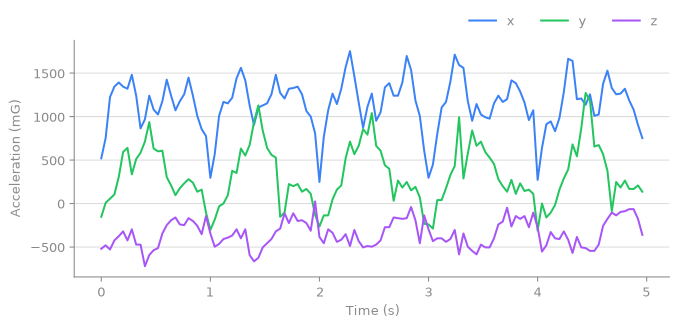
The following epoch of a walk shows the raw readings of each axis. Its dominant rhythm is the arm swing: there is one arm swing cycle for every two steps, and here the arm swing is strong enough to hide the foot falls.
The spectral density of the same walk, averaged over the whole sample to be less noisy than a single epoch, shows the energy at each frequency. Each axis, and their combination, is plotted relative to its own average power. The combined signal is the magnitude of the three axes at each frequency \(f\):
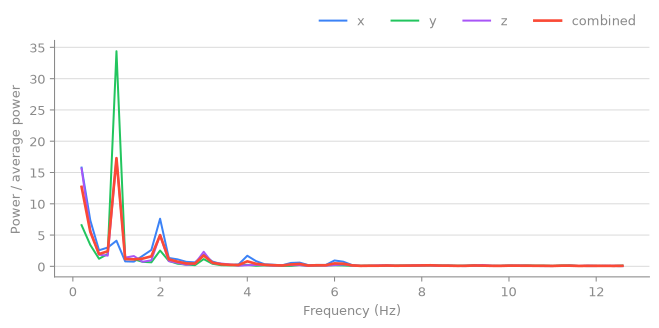
The arm swing dominates at 1 Hz, five swings in five seconds. The steps show at 2 Hz, together with the second harmonic of the arm swing, and the energy below 0.5 Hz comes from random arm movements rather than stepping.
Vector magnitude counts
Vector magnitude counts (VMC) measure the overall amount of movement over a period: 0 for a still watch, and more the more it moves, so running yields more than walking. They were developed with the Stanford Wearables Lab and calibrated against the ActiGraph wrist-worn device, which is widely used in medical research.
Each axis is first band-pass filtered between 0.25 Hz and 1.75 Hz. For \(N\) filtered samples \(\tilde{x}_n\), \(\tilde{y}_n\) and \(\tilde{z}_n\), with a calibrated scaling factor \(k\):
The accelerometer is sampled at 25 Hz, so one second of data is 25 samples per axis. The step algorithm computes a VMC over each 5 second epoch. It also computes one per minute, which it stores and sends to data logging, so it reaches the phone; apps read the minute values through the Health API.
Step identification
Spectral density
Each 5 second epoch holds 125 samples per axis. For the FFT, each axis has its mean subtracted and is zero-padded to 128 samples. The FFT of 128 real samples gives 64 frequencies; the amplitude of axis \(a\) at frequency index \(k\) is
and the three axes combine into the energy at that frequency:
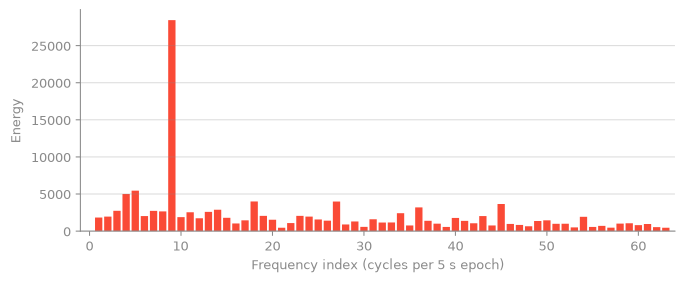
Index \(k\) is \(k\) cycles per epoch, \(k / 5\) Hz: index 0 is the DC component, and a user walking 9 steps every 5 seconds shows as a peak at index 9, 1.8 Hz. This epoch of a walk with little arm swing has a clear peak there:
Stepping frequency
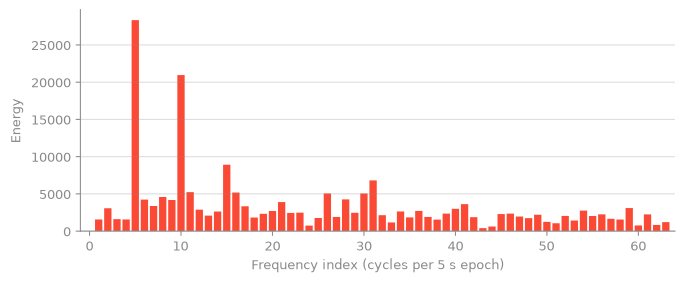
The naive approach takes the frequency with the most energy, which works for the epoch above. For some users, though, the arm swing is as strong as the steps or stronger, at half their frequency, so a quick walk can be mistaken for a slow one. In this epoch, the steps show at indices 9 and 10, but the arm swing at index 5 is larger:
The VMC narrows down where the steps can be. Based on it, the algorithm searches one of three frequency ranges, from a slow walk for a low VMC to a run for a high one, and takes the frequency with the most energy in it as the candidate.
Noise can put the maximum one or two indices off, or make neighbours nearly equal, as at indices 9 and 10 above. The algorithm refines the candidate with the harmonics, which carry significant energy for both the steps and the arm swing: for each stepping frequency \(s\) within two indices of the candidate, it adds up the energy of the steps, of the arm swing at half their frequency, and of their second to fifth harmonics,
and keeps the frequency with the highest total.
Stepping or not
That gives the stepping frequency if the user is walking; four checks decide whether they are. With \(\mathcal{S}\) the frequencies of the steps, the arm swing and their harmonics:
The walking score, the share of the energy in \(\mathcal{S}\), must be high:
\[W = \frac{\sum_{k \in \mathcal{S}} E[k]}{\sum_{k} E[k]}\]The VMC must be above a minimum stepping VMC, which is higher for a faster stepping rate.
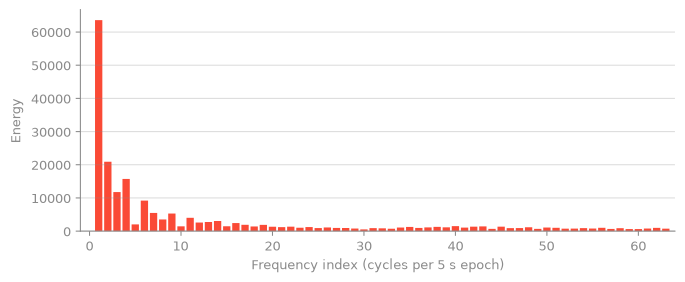
The energy at very low frequencies must be low relative to the signal:
\[R_\mathrm{low} = \frac{\sum_{k=0}^{4} E[k]}{\sum_{k \in \mathcal{S}} E[k]}\]must be below the low frequency ratio threshold. Many non-stepping epochs fail this check, like this one:
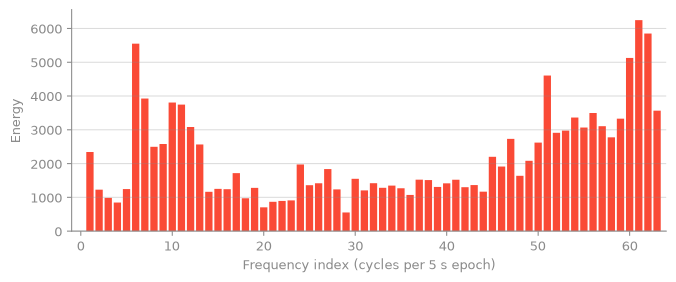
The energy at high frequencies must be low relative to the signal:
\[R_\mathrm{high} = \frac{\sum_{k \ge 50} E[k]}{\sum_{k \in \mathcal{S}} E[k]}\]must be below the high frequency ratio threshold. This keeps driving from counting as steps, as the engine’s vibration shows at those frequencies:
Partial epochs
An epoch in which the user starts or stops walking usually fails the checks above, and its steps would be lost. A partial epoch only needs a walking score and a VMC above lower thresholds of their own, with no frequency ratio checks. When a partial epoch is next to a stepping epoch, it adds half the steps of that epoch, which evens out the undercounting at the start and end of a walk. A walk shorter than two epochs can still go uncounted.
Sleep tracking
Sleep tracking works on two values per minute: the VMC, and the average orientation of the watch. The orientation is quantized to 8 bits, computed from the average reading of each axis over the minute: the angle in the X-Y plane in the lower 4 bits, and the angle of that vector with the Z axis in the upper 4.
Sleep detection
A minute is a sleep minute when its filtered VMC, a convolution of the VMC over the 4 minutes before and after it, is below the sleep threshold.
Sleep starts after at least 5 sleep minutes in a row.
Sleep continues until at least 11 non-sleep minutes in a row.
A sleep session must last at least 60 minutes.
With some exceptions:
A minute with an exceptionally high filtered VMC ends the session immediately.
In the first 60 minutes of a session, 14 non-sleep minutes in a row are needed to end it instead of 11.
If at least 80% of the minutes show slight movement, even below the non-sleep threshold, the user is considered awake.
If the watch was not worn, the session is discarded; see below.
Sleep minutes can instead be told apart by the van Hees classifier, which passes its verdicts to Kraepelin. The rules above then build sleep sessions out of them, with the same not-worn detection.
Restful sleep
A second pass over a sleep session finds its restful sleep. A restful sleep minute has a filtered VMC below the restful sleep threshold, lower than the sleep one.
Restful sleep starts after at least 20 restful sleep minutes in a row.
It continues until a minute that is not a restful sleep minute.
Not worn
A watch that is not worn looks asleep: it barely moves, and its VMC stays near 0. Every possible sleep session therefore goes through not-worn detection.
A not worn minute is one where either:
the raw VMC is below the not-worn threshold and the orientation is the same as in the previous minute; or
the watch is charging.
The watch is considered not worn when both:
there are at least 100 not worn minutes in a row in the session; and
that run starts within 20 minutes of the start of the session, and ends within 10 minutes of its end.
Restful sleep can approach 100 minutes, so the run has to be that long. The orientation check handles a watch on a table that picks up the occasional vibration: the VMC is then not zero, like the small movements of sleep, but a sleeping user is likely to change position, and so the watch’s orientation.