Characterization tools
The tools in tools/fuel_gauge/ run the
characterization of a cell and fit its
model. Their extra dependencies are in tools/fuel_gauge/requirements.txt.
Bench runs
bench.py runs the measurement procedure on an instrument: the charge, the
rest and the pulsed discharge down to the cutoff. The procedure and its
defaults are the same on every instrument. A backend in
tools/fuel_gauge/instruments/ runs it on its hardware: it charges with a
CC/CV profile until the charger terminates, runs a discharge profile down to
its cutoff, and logs both. Supporting an instrument means adding a backend
module and listing it in bench.INSTRUMENTS.
python tools/fuel_gauge/bench.py INSTRUMENT [instrument options] mycell_25c.csv \
    --capacity-mah 70 --vterm 4.45 --ichg 70
It writes the discharge log, the charge log next to it as
mycell_25c_charge.csv, and the settings as mycell_25c.json. --help
lists the profile’s options; --skip-charge starts from a cell that is
already full.
nPM1300-EK
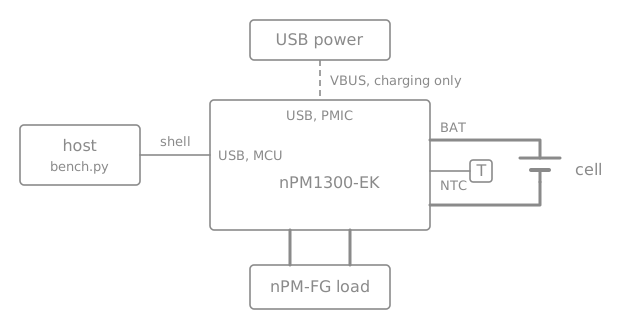
port while charging, the nPM-FG load on the EK, and the cell and its thermistor on the EK’s battery and NTC connectors
nPM1300-EK setup. The EK’s charger charges the cell, and the nPM-FG load board runs the discharge.
The npm1300-ek backend drives the EK’s shell over the interface MCU’s USB
port. The PMIC’s USB port powers the charger: connect it to charge and
disconnect it to discharge, when the backend asks. The voltage is measured
on the EK rather than at the cell terminals, so measure the resistance in
between, see Instrument. The EK can’t end a rest on a
voltage slope, so the rests have a fixed length.
python tools/fuel_gauge/bench.py npm1300-ek /dev/cu.usbmodemXXXX mycell_25c.csv \
    --capacity-mah 70 --vterm 4.45 --ichg 70 --ntc 10k
--ntc gives the thermistor type; without one, --temp gives the ambient
temperature to log.
Fit and replay
fuel_gauge.py works on the logs:
fitfits the model to bench logs, and prints the board’s battery node properties and Kconfig defaults.replayruns the firmware estimator over a log, with a model file or the model of a board’s firmware.synthsimulates the bench procedure on a model.extractturns the battery service’s verbose logs from a device into a log.
Log format
Every instrument writes the same CSV log, which is what the fit and the
replay read (tools/fuel_gauge/fuel_gauge_log.py):
Column |
Unit |
|
|---|---|---|
|
s |
from the start of the log |
|
V |
at the cell |
|
A |
positive when discharging |
|
°C |
|
|
optional: |
Each row’s current is taken as held over the interval since the previous row, like on the device.