SF32LB52 RC10K
The SF32LB52 can run its low-power clock from a 32.768 kHz crystal. Without one, the low-power clock is the RC10K, an RC oscillator near 9.66 kHz that keeps running in deep sleep. It drives the system clock source (LPTIM1), the calendar RTC and the LPTIM PWM, so every error in its assumed rate is an error in the kernel’s time.
drivers/clk/sf32lb_rc10k.c provides it as a calibrated clock, SF32LB_RC10K. This page describes the hardware, the oscillator
as measured on a watch, the vendor algorithm it replaces and the results.
Hardware
The Bluetooth controller’s RCCAL counter counts 48 MHz crystal cycles over
\(N\) RC10K cycles (CONFIG_CLK_SF32LB_RC10K_CAL_GATE_CYCLES, 2000 by default,
207 ms). The counter resolution is 0.1 ppm.
The LCPU calibrates the RC10K on its own with the same counter, for its Bluetooth sleep timing, and never uses this estimate. A mailbox mutex serializes the two: the driver retries a second later if the LCPU holds it, and the LCPU, finding it taken, retries from its next idle hook. For the duration of a gate the driver keeps the low-power domain awake and the crystal requested, and lets the CPU sleep. The LCPU owns the low-power domain’s clock selection: the driver only checks that it runs from the crystal, as it does with Bluetooth on and in airplane mode.
At init, the low-power domain does not run from the crystal yet, so the rate starts at the nominal 9.66 kHz and gates are retried every second until one succeeds, about 3 s into boot, after the LCPU has started. That first gate replaces the nominal rate outright. The nominal rate is only a placeholder: on one watch, the RC10K ran at 9658 Hz before a power cycle and 9555 Hz after it.
The system clock source and the RTC follow the rate through notifiers; the RTC prescaler can be rewritten while the calendar runs, so the calendar keeps its time across updates. The PWM reads the rate when it programs its prescaler.
The oscillator
White frequency noise
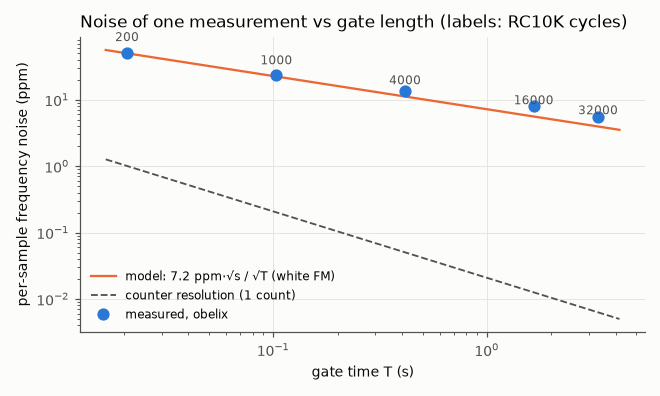
Consecutive gates scatter with a two-sample deviation of \(7.2\,\mathrm{ppm}\cdot\sqrt{\mathrm{s}} / \sqrt{T}\), white frequency noise: 50 ppm for a 200-cycle gate, 16 ppm for 2000 cycles.
Wander, load, temperature and supply
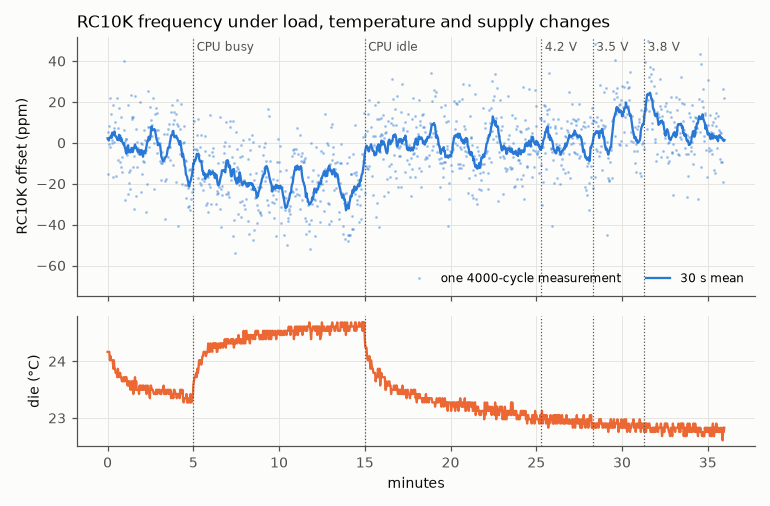
Averaged over 30 s, the frequency still wanders by about ±8 ppm on a timescale of a minute or two. It also steps by about −20 ppm when the CPU goes from idle to busy and back when it idles again. The die warms by only 1.2 °C meanwhile: the step follows the load, not the temperature. Moving the battery voltage between 3.5 and 4.2 V has no visible effect.
Deep sleep
To see the frequency in deep sleep, the kernel rate was frozen and the watch left idle, waking for a few seconds a minute to take one 4000-cycle gate, with the CPU spinning, and report its time to the host. The slope of the kernel’s time against the host’s is the true mean rate.
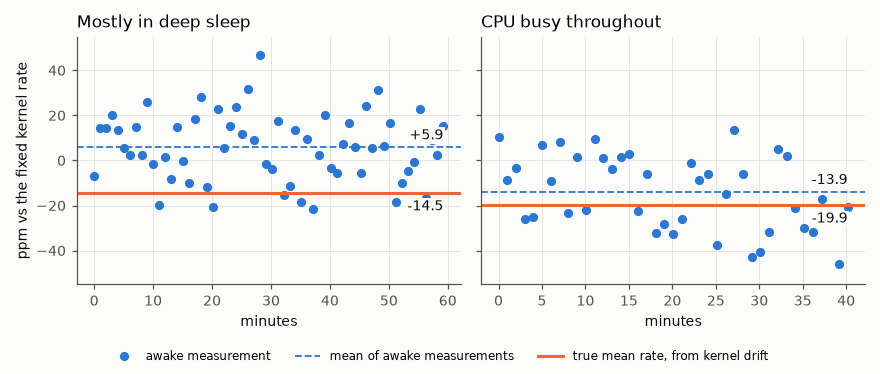
Mostly asleep, the true mean rate is 20 ppm below the mean of the awake gates (±2 ppm over 60 minutes). With the CPU busy throughout, the two agree within 6 ppm. The RC10K runs slower asleep and under load than in the lightly loaded state a calibration runs in.
Parameters
From these measurements: wfm 7.2 ppm·√s, wander 8 ppm and rw
1.1 ppm/√s. With a 2000-cycle gate once a minute, the steady state is
\(K = 0.38\), \(\tau = 2.1\) minutes and \(\sigma = 10.9\) ppm:
Gate |
Period |
\(K\) |
\(\tau\) |
Estimate σ |
Average current |
|---|---|---|---|---|---|
200 cycles (vendor EWMA) |
60 s |
0.125 |
7.5 min |
13.1 ppm |
|
2000 cycles |
60 s |
0.38 |
2.1 min |
10.9 ppm |
2.1 µA |
4000 cycles |
60 s |
0.46 |
1.6 min |
9.3 ppm |
4.3 µA, scaled |
A gate draws about 580 µA for its duration: 128 µC for 2000 cycles, measured with a PPK2 at 3.8 V.
The vendor algorithm
The vendor algorithm measures a 200-cycle gate once a minute, with the CPU spinning for the 21 ms, and keeps an exponential average of the counts in integer arithmetic:
switching to a gain of \(13/16\) after two consecutive samples beyond +250 or −200 counts. With 50 ppm per sample, the average settles to 13 ppm of noise with a time constant of 7.5 minutes. It also:
never resets its failure counter, so its recovery from a stuck estimate works once per boot;
rejects samples more than 5000 counts from the average, so a large enough step freezes the estimate for good;
rounds the update to whole counts, a dead band of up to 4 ppm;
starts each boot from one raw sample and, after a power loss, from a nominal 10 kHz, 3.5 % off.
Results
Replay
Replayed against the measured trajectory with one update a minute, the native filter’s time error stays within 6 ms over 35 minutes (median of 200 noise realizations; 10 ms at the 90th percentile), against 17 ms (37 ms) for the vendor algorithm. Most of the difference is the load step, which the vendor average takes a quarter of an hour to follow.
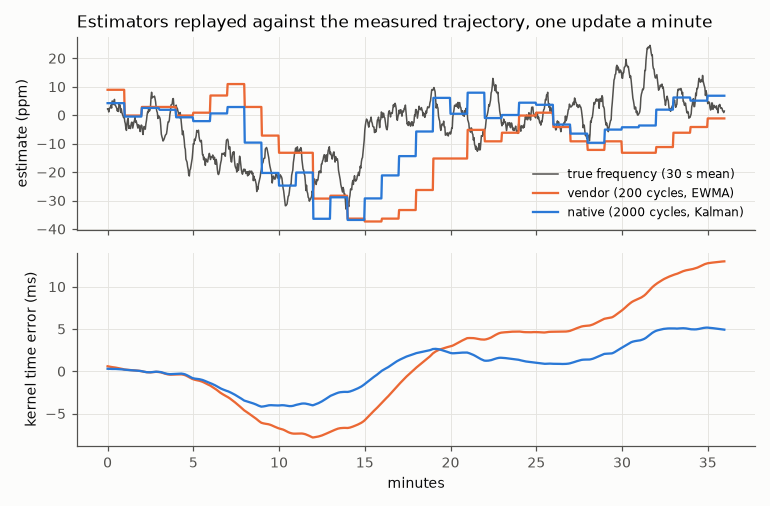
Over a day, the estimate noise accounts for 0.05 s with the 2000-cycle gate and 0.12 s with the vendor algorithm. The sleep bias dominates both.
On the device
An idle watch reported its time to the host every five minutes for two hours, once with each algorithm. With the 2000-cycle gate once a minute, it ran 9.9 ppm slow (0.85 s a day), within 2.7 ms rms of a straight line. With the vendor algorithm, it ran 13.6 ppm slow (1.17 s a day), within 7.4 ms rms.
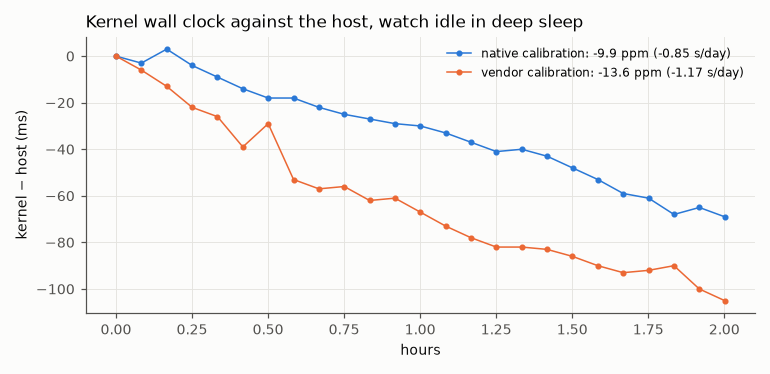
The CPU sleeps through the driver’s gates, so they see less of the awake bias than the spinning gates above: half of it remains. Correcting it needs a reference while the watch runs, such as the phone’s time.
Both algorithms cost about the same: the vendor gate is ten times shorter, but the CPU spins through it, adding about 130 µC to the minute’s activity.